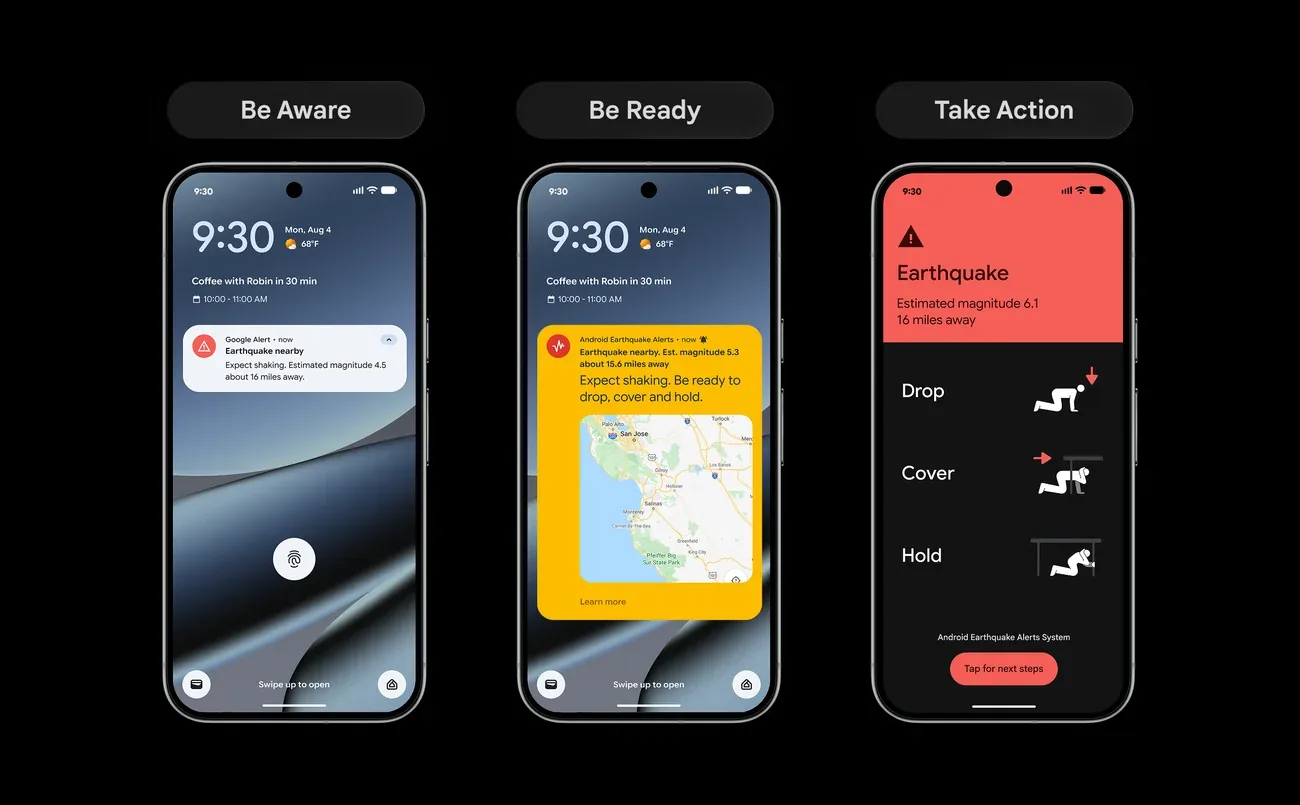
Google announced the wider Android Earthquake Alerts rollout on 15 October 2026. Availability, timing and alert delivery can vary; the system cannot guarantee warning before every earthquake.
Google announced on 15 October 2026 that Android Earthquake Alerts would expand from 98 to more than 200 countries and regions. The company said the rollout was starting that day and expected it to complete within a week. As of our 20 October source check, that timetable should be read as a rollout plan, not proof of availability on every phone.
Separate the rollout from the later features
The announcement describes three alert levels: Be Aware, Be Ready and Take Action. It also says further map information for Be Ready alerts, including the estimated affected area and magnitude, is planned for the coming months.
| Item | Status described by Google | Reader takeaway |
|---|---|---|
| Broader country and region coverage | Rollout announced for the week beginning 15 October | Check availability on your own device |
| Additional alert-map information | Planned for the coming months | Do not expect every illustrated feature immediately |
| A specific earthquake notification | Depends on detection and alert delivery | Availability is not a guarantee of advance warning |
Check the setting without assuming a guarantee
Google’s help page directs users to Settings, Safety & emergency, then Earthquake alerts; some phones use Location and Advanced instead. It says alerts require Wi-Fi or mobile data, are not available everywhere, and may arrive before, during or after shaking. Not all earthquakes are detected, and estimates can be wrong.
What this means for a phone owner
The practical task is to verify whether the option appears on your phone and read the information it presents. A news headline about expanded coverage does not establish that a particular device, software version or location is already covered. If the menu differs, consult the device maker’s instructions rather than installing an app that claims to unlock a system setting.
This is also a useful example of how to read a product announcement: identify the announcement date, the rollout window and any later commitments. Those are three separate pieces of information. Treat a feature described as “coming” as a plan until its availability can be confirmed.
Scope of this report: source-based coverage of Google’s announcement and help documentation. NewsHoxs has not tested alert delivery or earthquake detection performance.
For longer-term phone ownership, our software support guide explains how to check a manufacturer’s update commitments.
What to check on the phone you actually carry
Check the available Earthquake Alerts setting on the device, confirm the normal connectivity it relies on and keep the phone’s software current. A family plan should also include local emergency instructions and a way to communicate if ordinary connectivity fails. Do not make preparedness depend on receiving a phone notification.
Treat rollout language carefully
An announcement date marks when a company described a rollout. It does not prove that every eligible device has the same screen immediately. If an option is missing, distinguish device eligibility, regional availability and staged delivery before concluding that the handset is faulty.
The useful next check is the setting on your device and the local emergency guidance for your area. Features described as arriving later should stay labelled as future plans until their availability is confirmed. A broader footprint is useful context, but it is not a measurement of how much warning a particular person will receive.

Amelia Brooks
Editorial pen namePractical guides to phones, two-wheelers and gaming from the NewsHoxs desk. Read the bio & browse all stories ↗
See our coverage methodology or send a correction.