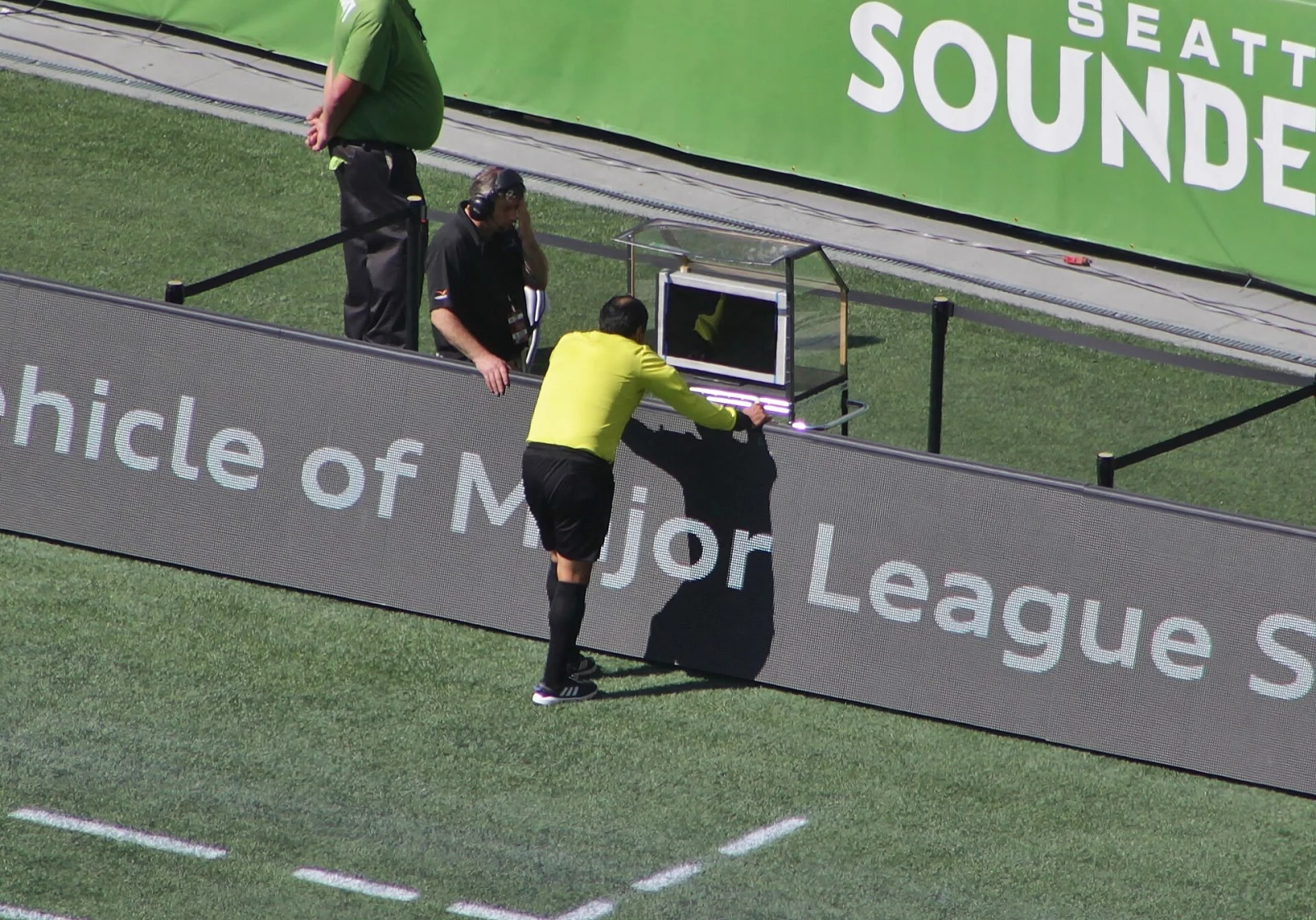
A VAR check is not the same thing as a referee reviewing an incident. Many checks finish without a visit to the pitchside screen. To follow the process, keep the original on-field decision separate from the video team’s check and any later decision to review.
This explainer follows IFAB’s 2026/27 protocol. Check the competition and season when watching an older match or an event operating under different approved arrangements.
Start with the decision already made
The referee makes an initial decision, which can include allowing play to continue. VAR checks incidents within the protocol’s scope, such as goal and penalty decisions. A check can be completed without an obvious public interruption.
Only the referee initiates a review; VAR can recommend one. The final decision remains the referee’s. Players do not gain a general right to demand a video appeal because a replay looks controversial.
Read the sequence, not just the gestures
| Stage | What to identify | Avoid this assumption |
|---|---|---|
| Original decision | The call made on the field, including play continuing | No whistle means no decision existed |
| Check | Whether the incident needs further action within the protocol | Every check requires the screen |
| Review | The question being reconsidered and the review method | A monitor visit guarantees a reversal |
| Final ruling | The announced decision and restart | A broadcaster’s early graphic is the ruling |
Use this as a viewing worksheet. Note the original decision in a few words, then the specific disputed point. “Goal given; possible offside earlier” is more useful than writing “VAR drama,” because it preserves the question the officials need to resolve.
Why some incidents use the screen
The protocol distinguishes factual information from subjective judgements when describing VAR-only and on-field reviews. Replay speed also matters to the question being examined. A freeze-frame useful for position does not, by itself, explain the intensity of contact.
As a viewer, ask what the picture can establish. Is the discussion about a location or timing, or about how an action should be judged? The answer helps explain the review method, but it does not let a spectator replace the officials with one cropped image.
A hypothetical goal with an offside question
Suppose a goal is awarded and the check concerns the position of an attacker when a teammate played the ball. Begin with that passing moment. Next identify the relevant player and whether the eventual involvement makes the position an offence.
Our offside guide explains position and active involvement. Keep those questions separate from the VAR process. Knowing which stage is happening does not settle whether the underlying offside decision is correct.
If the broadcast then shows the referee listening to an earpiece, do not invent a second controversy. Wait for the information and final ruling. Your notes should say what was actually checked, rather than what a replay commentator initially suspected.
Keep the 2026/27 changes attached to their conditions
The 2026/27 protocol includes clearly incorrect second cautions within its red-card provisions. It also allows competitions to use VAR for a clearly incorrectly awarded corner, subject to immediate correction without delaying the restart. These are not permission to review every routine restart.
That makes the rule-set label important. An older statement that a second yellow can never be reviewed is too broad for the current protocol. A clip from another season cannot establish what a present competition has adopted.
What to record when the decision takes time
Record the incident, the initial call, the review question and the final ruling. There is no fixed maximum review time in the protocol; a long wait does not itself identify the outcome.
After the ruling, compare your notes with the official explanation if one is issued. If the available pictures never show the crucial moment, leave that gap visible. “The broadcast did not show the relevant angle” is a more accurate conclusion than treating uncertainty as proof of an error.

Amelia Brooks
Editorial pen namePractical guides to phones, two-wheelers and gaming from the NewsHoxs desk. Read the bio & browse all stories ↗
See our coverage methodology or send a correction.