Plan range around your route and a reserve. Certified range and a dashboard estimate should not be treated as a promise that every charge covers the same distance.
The most useful range question is specific: can this scooter cover your ordinary day, an unexpected detour and the journey to a dependable charger? A headline distance is a comparison input. Your route and charging access decide whether ownership will be convenient.
Read the label attached to the range claim
Ather explains IDC range as a figure produced under standardised Indian Driving Cycle testing. The route, load, riding mode and conditions of an actual commute can differ. Treat the certified number and a manufacturer’s real-world estimate as different claims, and ask which one is being quoted. Ather’s explanation is a manufacturer source, not an independent road test.
Write the model, variant, battery version and test basis beside every quoted distance. Comparing a certified figure for one scooter with an informal rider result for another gives a misleading impression of precision.
Build the day before estimating the battery
| Journey | Example distance | Question to resolve |
|---|---|---|
| Home to work and back | 32km | Is this the actual route or a straight-line estimate? |
| Regular errands | 8km | How many days a week do you make them? |
| Possible detour | 10km | What happens if your usual route is closed? |
| Example day total | 50km | Can you recharge reliably before the next day? |
These distances are an example, not a recommendation for every rider. Include a second day if charging is only available every other night. A short commute with unreliable charging can be less convenient than a longer one with dependable access at home.
Use energy arithmetic to expose assumptions
A basic estimate divides usable battery energy in watt-hours by consumption in watt-hours per kilometre. Ather’s range calculation guide discusses this relationship. Usable energy is the relevant input; do not silently substitute a pack’s advertised gross capacity.
Illustrative calculation: 3,000Wh of usable energy ÷ 35Wh/km = about 86km. At an assumed 45Wh/km, the same arithmetic gives about 67km. Neither figure is a measured range result or a promise for a specific scooter.
The example shows why a single optimistic consumption estimate is fragile. Ask the seller for the conditions behind its estimate, then leave enough flexibility for your own route and charging plan. A reserve should reflect your situation and manufacturer guidance, not a universal percentage copied from an article.
Check the ownership constraints at the same time
- Where will the vehicle charge, and is that location actually available to you?
- What installation and electrical requirements does the manufacturer specify?
- Is the quoted charging time for the battery interval you will normally use?
- Where is the nearest service point, and what is the process for a charging fault?
- What battery warranty conditions apply to the exact variant being offered?
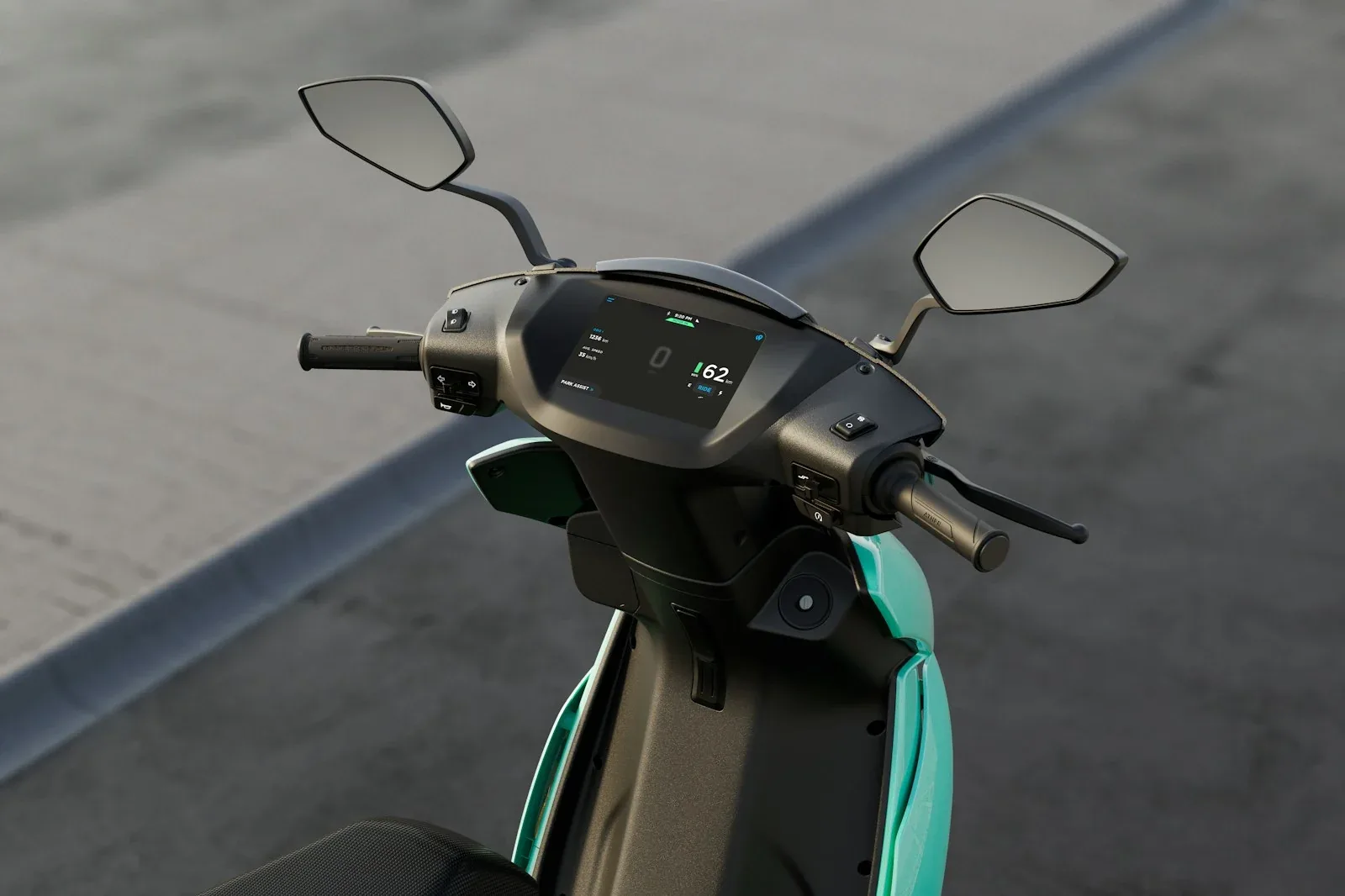
Use a documented demonstration or your own permitted test ride to ask focused questions about the intended route. This guide contains no NewsHoxs road-test measurements. The photograph is illustrative.
Looking at a bicycle with motor assistance instead of a scooter? Our pedal-assist e-bike guide covers a different set of practical checks, including lifting, fit and removable batteries.
Work an energy budget before a long detour
For an illustrative calculation, assume 2,700 Wh of usable energy and an average of 35 Wh/km. Dividing gives about 77 km. Reserving 20% leaves 2,160 Wh for planned travel, or about 62 km at the same consumption. At 45 Wh/km, that planned distance falls to 48 km. These are mathematical scenarios, not measured figures for a scooter.
The calculation is only as useful as its inputs. Do not substitute the battery’s advertised total capacity for usable energy without confirmation, and do not borrow another rider’s consumption as a guarantee. Use your own repeatable route observations once you own the vehicle.
Does a bigger battery remove charging planning?
It can give more flexibility, but the parking and charging arrangement still decides whether ownership is convenient. Include the days when your route changes, a charger is unavailable or you return later than expected. Keep a fallback that does not depend on arriving with almost no charge.

Amelia Brooks
Editorial pen namePractical guides to phones, two-wheelers and gaming from the NewsHoxs desk. Read the bio & browse all stories ↗
See our coverage methodology or send a correction.