Artistic gymnastics becomes easier to follow when you stop looking only at the final landing. The score also reflects the routine’s difficulty, the quality of the movement between skills and the specific demands of the apparatus. A dramatic routine can lose to a less ambitious one performed with greater control.
For a first competition, begin with three questions: which apparatus is being used, what kind of result is being decided and how the displayed score is split. You do not need to memorize every skill name to understand the contest.
Start with the right kind of gymnastics
The beam, bars, rings and vault belong to artistic gymnastics. Rhythmic gymnastics and trampoline are separate disciplines with their own events and judging structures. A scoring explanation for one should not be applied automatically to another.
Within artistic gymnastics, women compete on four apparatus and men on six. Floor and vault appear in both programmes, but that does not mean the routines, requirements or scores are interchangeable. Read the event label before comparing performances.
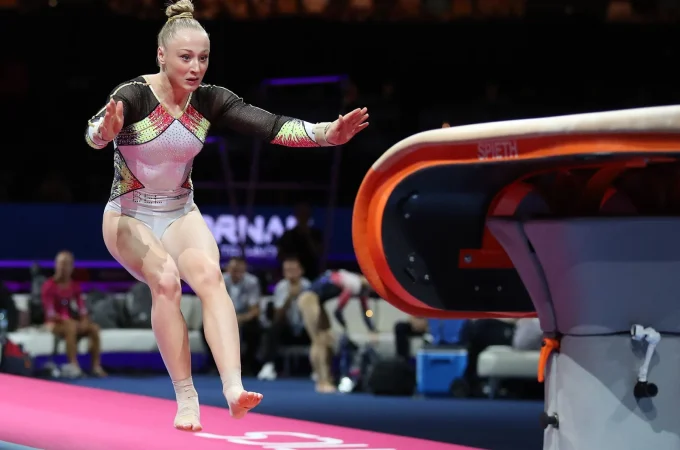
The apparatus at a glance
| Programme | Apparatus | What the event asks you to notice |
|---|---|---|
| Women | Vault | The approach, flight over the table and controlled finish |
| Women | Uneven bars | Swinging work, releases and movement between two bars |
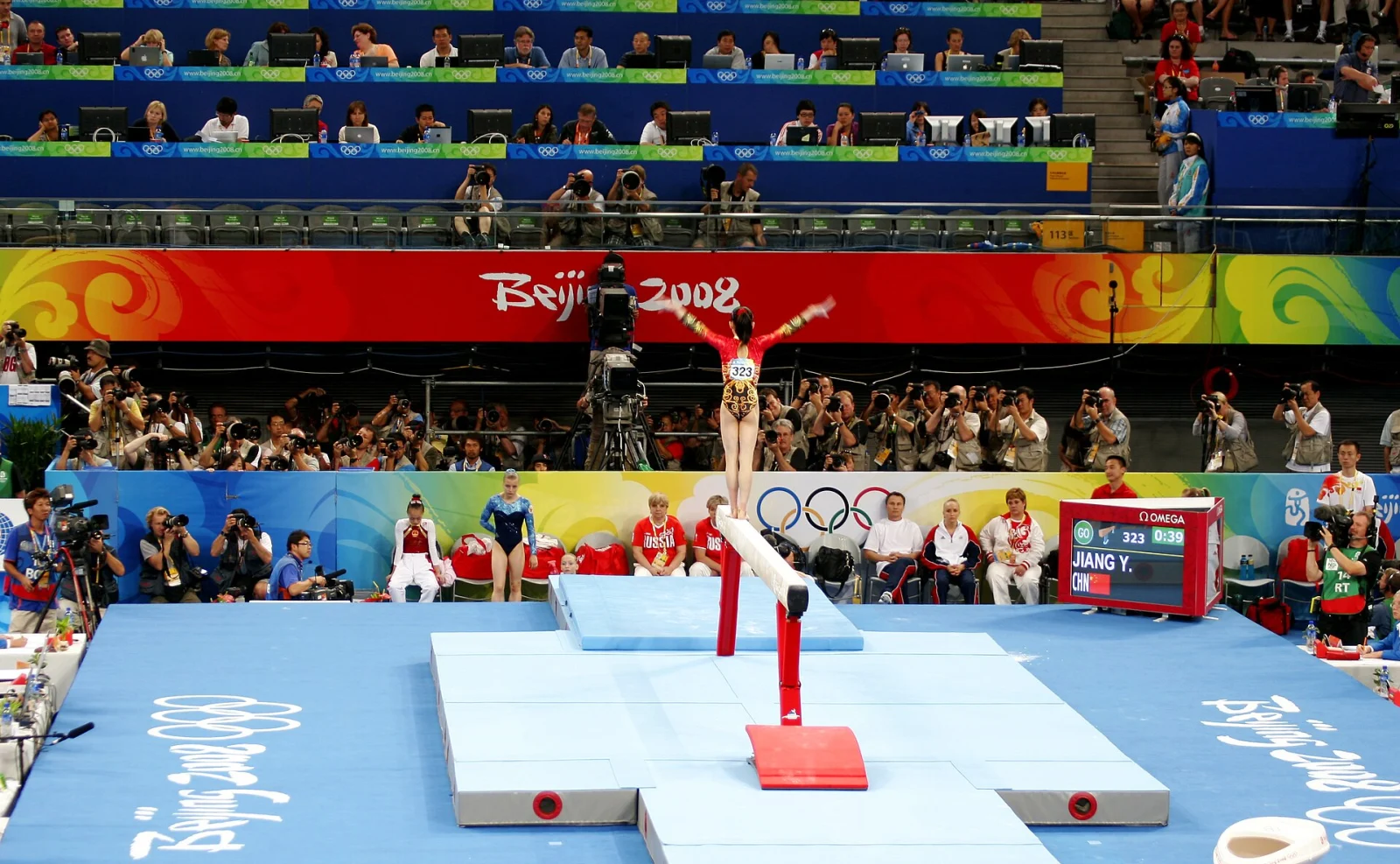
| Women | Balance beam | Acrobatics, turns and balance on a narrow surface |
| Women | Floor exercise | Tumbling combined with dance and choreography to music |
| Men | Floor exercise | Tumbling and non-acrobatic strength or balance elements |
| Men | Pommel horse | Continuous circles, travel and support through the hands |
| Men | Still rings | Strength positions and controlled transitions |
| Men | Vault | Flight and the finishing control after the table |
| Men | Parallel bars | Supported and swinging work above and around two bars |
| Men | Horizontal bar | Swinging, release moves and the dismount |
The governing body’s apparatus guide describes the balance beam as only 10cm wide. That gives useful context to a hesitation or adjustment: the gymnast is controlling a full routine on a surface much narrower than it can appear in a wide television shot.
Read difficulty and execution separately
The two headline components are the difficulty score, usually shown as D, and the execution score, shown as E. Difficulty reflects the credited content of the routine. Execution reflects how the exercise is performed; in women’s artistic gymnastics, the assessment also includes artistry.
The current women’s Code of Points starts the execution assessment from 10.000 and subtracts the relevant deductions. The final routine score combines D and E, with applicable penalties then taken away. Some apparatus calculations have additional rules, particularly vault qualification and finals, so use the event’s official breakdown for the result being shown.
That is why the overall result is not a simple mark out of ten. It also explains why two routines that look similarly clean may have different totals: they may not have been credited with the same difficulty.
A worked example: harder does not always mean higher
Imagine two beam routines at the same competition. The following figures are invented solely to show the arithmetic; they are not an athlete’s results. Assume no neutral penalties apply.
| Routine | Difficulty | Execution | Final score |
|---|---|---|---|
| A | 5.2 | 8.3 | 13.5 |
| B | 5.8 | 7.5 | 13.3 |
Routine B starts with a 0.6-point advantage in difficulty, but Routine A earns 0.8 more in execution. A therefore finishes 0.2 ahead. If a separate 0.1 penalty applied to A, its total would become 13.4, still above B’s 13.3.
Use that relationship when watching, rather than assuming the most spectacular skill must decide the winner. The example does not set a universal good score. Compare routines within the same event and competition context, because apparatus requirements and rules differ.
Know which result the session is deciding
An apparatus final identifies the strongest performance on a particular apparatus. An all-around result combines a gymnast’s scores across the apparatus in their programme. A team result uses the team format and counting rules specified for that competition.
Those are different questions. An excellent specialist may be the athlete to watch on one apparatus without being an all-around contender. A team may also value a dependable contribution differently from a high-risk individual attempt. Check the session title and official format instead of assuming every round produces the same kind of ranking.
Vault makes that distinction especially visible. Our senior women’s one-vault and two-vault scoring guide shows the apparatus average and keeps the current conditional bonus separate from the individual scores.
Watch one routine in three passes
For a first viewing, follow the routine as a whole. Notice whether it keeps moving, where the gymnast seems in control and how the finish relates to what came before. Resist trying to count every rotation while also following the broadcast.
On a replay, choose one detail. On beam, follow the transitions between elements. On bars, watch the relationship between a release and the next catch. On floor, notice how the tumbling and the rest of the routine fit together. These are viewing prompts, not a substitute for the judges’ detailed criteria.
Finally, look at the score breakdown. Ask whether the difference came mainly from difficulty, execution or a separate penalty. If your first impression disagrees with the total, that is a useful question to investigate through the official result rather than a reason to guess at a deduction.
A quick checklist for the next broadcast
- Read the event: identify the discipline and apparatus before comparing scores.
- Read the round: check whether it is qualification, an all-around contest, a team session or an apparatus final.
- Separate D and E: a higher difficulty score is only one part of the total.
- Look beyond the landing: notice the control and continuity through the routine.
- Use the official result: the broadcast graphic may not show every adjustment or the full competition format.
Once those basics become familiar, skill names and detailed requirements are easier to place. Begin by understanding what the routine is trying to achieve, then use the score to see how well its ambition and execution came together.

Amelia Brooks
Editorial pen namePractical guides to phones, two-wheelers and gaming from the NewsHoxs desk. Read the bio & browse all stories ↗
See our coverage methodology or send a correction.